
Custom Stainless Steel Spring Tube
Project Background
Our company has long been dedicated to the R&D and manufacturing of push-pull outer casings, flat wrap steel cable outer casings, PTFE tubes for the electronic medical industry, and various high-precision small-diameter tubular materials, with 30 years of mature process capabilities and a comprehensive quality control system. The customer in this project is a high-end equipment manufacturer. Since their core components need to operate stably for extended periods in high-temperature, humid, and mildly corrosive environments, they commissioned our company to develop a stainless steel spring tube meeting specific structural requirements. The customer provided preliminary drawings with the order, requiring our company to achieve full compliance with all dimensional and performance specifications.
Customer Requirements
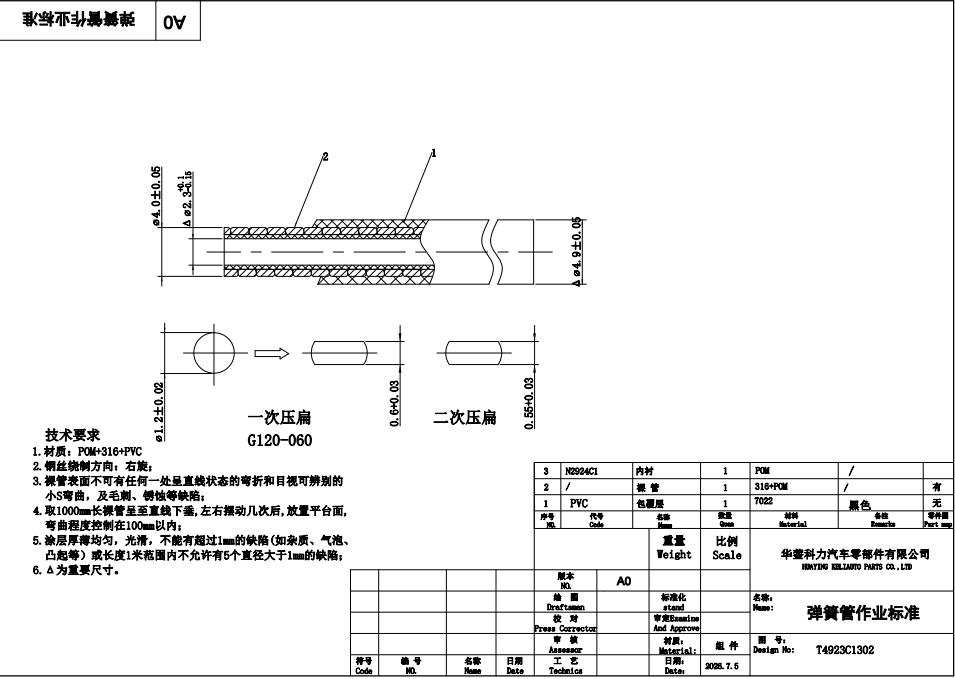
Based on the drawings and technical specifications provided by the customer, the core requirements are as follows:
- Material: Stainless steel to ensure corrosion resistance and mechanical strength;
- Structural composition: Inner layer of PCM, outer layer of PVC coating, overall black in color;
- Dimensional accuracy: Key dimensions such as spring tube outer diameter, inner diameter, pitch, free length, and compression stroke must strictly conform to the tolerances indicated on the drawings;
- Performance indicators: The spring tube must have a stable elastic coefficient under rated load, with reciprocating compression life no less than the customer-specified number of cycles, and the PVC coating must be firmly adhered with no cracks;
- Delivery requirements: The first batch order must be delivered on schedule with qualified mass-produced products, accompanied by traceable inspection records.
Project Challenges
During the technical review after receiving the drawings, our engineering team identified the following main difficulties:
Forming precision and rebound control: Stainless steel has a high yield strength, and internal stress release after spring winding easily leads to pitch and outer diameter deviations. The tolerance range given in the drawings is narrow, making it difficult for conventional processes to consistently meet the standards;
Coating adhesion and appearance consistency: The PVC coating must uniformly cover the outer surface of the spring tube, and the black color shade 7022 requires consistent coloration. However, at the bent portions of the spring, the coating is highly susceptible to peeling or thickness variation due to uneven heat shrinkage;
Mass production consistency: Manual or semi-automatic methods make it difficult to ensure high repeatability of elasticity and dimensions across each batch, while the customer requires a 100% sampling pass rate during mass production supply.
Solutions
In response to the above challenges, our company implemented systematic optimization from two aspects: material and structural process:
Material:
Based on the project’s actual service conditions (involving elastic modulus, tensile strength, and pitting corrosion resistance requirements), our company conducted systematic process trials and performance comparisons on candidate stainless steel grades such as 304 and 316. Given that 316 is more suitable for the spring tube’s long-term operating environment in terms of stress corrosion resistance and high-temperature stability, and that the company had no material grade constraints at the project’s initial stage with flexible material selection, after internal technical review, S316 stainless steel was ultimately selected as the tube blank base material.
Structure and Process:
We adjusted the tube pre-treatment process before spring winding, improved PVC coating process parameters, and established a first-article full inspection + in-process SPC control system. For each batch of spring tubes, sampling inspections of outer diameter, pitch, free length, spring force, and coating adhesion (cross-cut method) are conducted, and mass production proceeds only after data stability is confirmed.
Results Achieved
Through the above optimization measures, the project achieved significant results:
- Dimensional pass rate: In the first mass production batch, 100 samples were inspected, and all key dimensions were within the drawing tolerance range. The dimensional pass rate increased from 78% in the trial production stage to 100%;
- Coating quality: PVC coating adhesion reached Grade 0 (cross-cut method), black color difference ΔE ≤ 1.0, with uniform appearance, no bubbles, and no flow marks;
- Fatigue life: Under the customer-specified test conditions, the spring tube’s reciprocating compression life reached 1.2 times or more of the design requirement, with no fracture, plastic deformation, or coating detachment;
- Delivery timeliness: From order acceptance to first batch qualified product delivery, the project was completed 3 working days ahead of the customer’s original delivery date, with complete dimensional inspection reports, material quality certificates, and coating performance test data provided with the shipment.
Customer Feedback
“Your company overcame the forming and coating challenges of the stainless steel spring tube in a short time, demonstrating deep mold development capability and process control expertise. The delivered products have precise dimensions, stable performance, and coating appearance that fully meets the standards.”
Start a Collaboration by Starting with a Customized Sample