Choosing the right control cable conduit is important for reliable mechanical control in automotive systems. A properly selected conduit protects the inner cable while maintaining the required flexibility, compression resistance, bending performance, dimensional stability, and smoothness of cable movement.
In automotive applications, selecting the right cable is more than just choosing the cable diameter. In engine compartments, transmission systems, doors, hoods, trunks, and interior mechanisms, an automotive control cable conduit may be subjected to different combinations of temperature, vibration, repeated bending, abrasion, moisture, oil, and external compression. The correct control cable housing is selected based on cable design, routing geometry, mechanical load, operating environment, and required service life.
What Is an Automotive Control Cable Conduit?
An automotive control cable conduit is the outer protective structure that surrounds and guides an inner cable or wire rope. It allows the cable to transmit movement between an actuator and a controlled mechanism while protecting the cable from mechanical and environmental conditions.
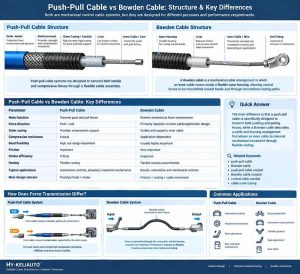
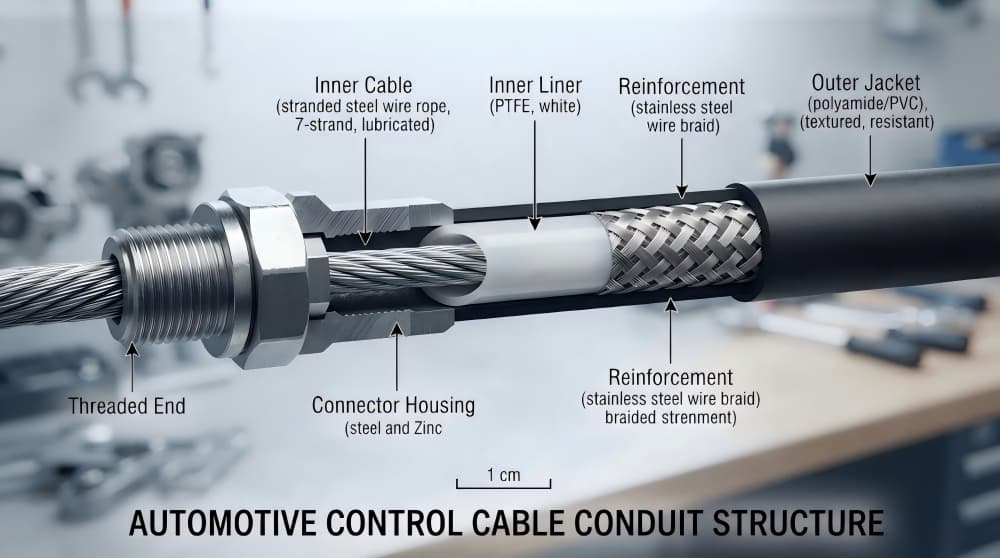
A typical control cable system consists of several functional layers: Inner Cable, Inner Liner, Reinforcement, and Outer Jacket
| Component | Main Function |
| Inner cable | Transmits pulling or push-pull force |
| Inner liner | Guides the cable and controls the cable-to-conduit interface |
| Reinforcement | Provides compression resistance and dimensional stability |
| Outer jacket | Protects the system against abrasion and environmental exposure |
This means a control cable casing is not simply a protective tube. Its construction can influence cable friction, bend performance, operating force, compression resistance, and long-term durability.
A Bowden cable conduit, for example, must maintain the correct relationship between the inner cable and outer conduit while allowing the cable to follow the required routing path. The same principle applies to automotive hood releases, door-lock systems, transmission controls, and other mechanical actuation systems.
What Factors Should You Consider When Choosing a Control Cable Conduit?
The correct control cable conduit should be selected according to both the cable's mechanical requirements and its installation environment. Before choosing a construction, evaluate:
| Selection Factor | What to Check | Why It Matters |
| Inner cable diameter | Cable size and required clearance | Ensures compatible movement |
| Conduit ID/OD | Available installation space | Prevents interference |
| Bend radius | Minimum routing radius | Controls friction and cable stress |
| Flexibility | Static and dynamic bending | Affects cable movement |
| Compression resistance | External loading | Prevents conduit deformation |
| Temperature | Actual operating conditions | Determines material suitability |
| Abrasion | Contact with surrounding parts | Influences service life |
| Chemical exposure | Oil, grease, water and chemicals | Determines material selection |
| Cable stroke | Required movement | Influences system performance |
| Installation space | Routing and fixing constraints | Determines conduit construction |
Inner Cable Diameter and Conduit Dimensions
The conduit ID must provide sufficient clearance for the inner cable to move without excessive resistance. At the same time, unnecessary clearance can affect cable guidance and system consistency.
Important dimensions include:
- Inner diameter
- Outer diameter
- Wall thickness
- Length
- Dimensional tolerance
These dimensions should be evaluated together with the inner cable, liner, fittings, and end connectors.
Flexibility and Control Cable Conduit Bend Radius
Bend radius is one of the most important selection parameters for an automotive control cable conduit. A conduit that is too rigid for the routing path can restrict cable movement, while an excessively tight bend can increase cable-to-liner contact.
An unsuitable bend radius can contribute to:
- Increased operating friction
- Cable binding
- Uneven stroke
- Accelerated wear
- Reduced service life
The minimum bend radius should therefore be evaluated under the actual installation conditions, including cable movement and repeated bending.
Compression Resistance
Automotive control cables may pass through clips, brackets, channels, or confined spaces where external forces act on the conduit.
If the conduit deforms excessively, internal clearance can change and cable movement may become less consistent. For demanding applications, reinforced constructions can provide greater dimensional stability and anti-crush performance.
Temperature and Environmental Exposure
Temperature requirements depend heavily on installation location. An engine compartment, transmission area, underbody system, and interior mechanism can have very different operating environments.
Evaluate exposure to:
- Heat
- Oil
- Grease
- Water
- Dust
- Road salt
- Chemicals
- UV
- Mechanical abrasion
Material selection should be based on the actual application rather than a generic automotive rating.
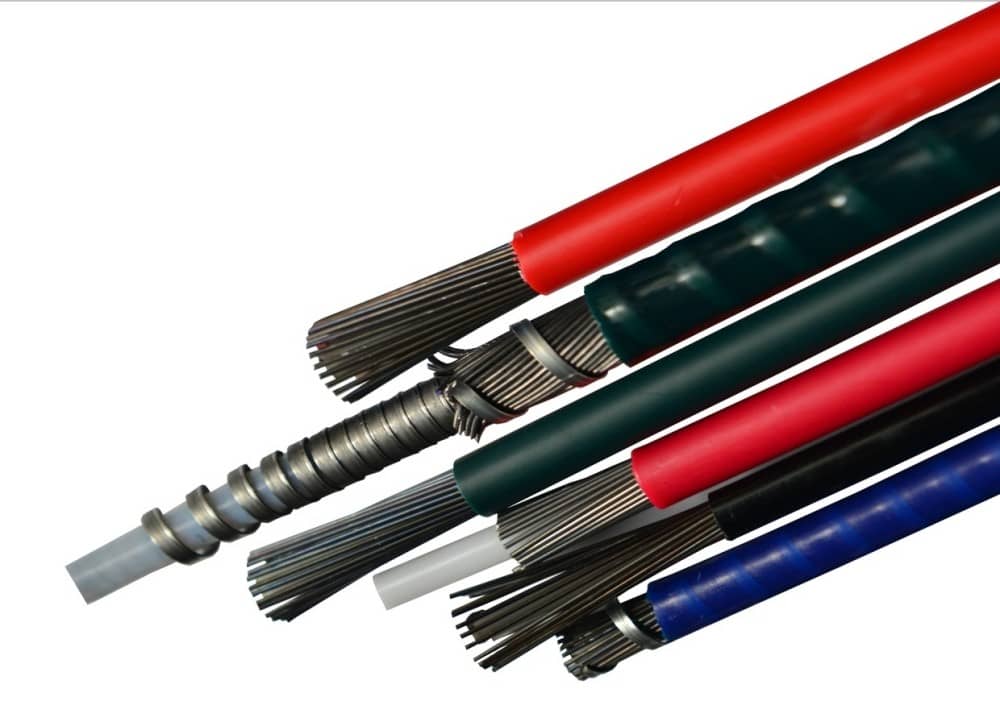
Which Type of Control Cable Conduit Should You Choose?
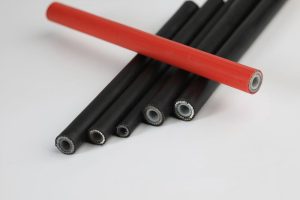
Different conduit constructions provide different combinations of flexibility, reinforcement, compression resistance, and routing stability.
| Conduit Type | Primary Characteristic | Typical Selection Consideration |
| Push-Pull Outer Casing | Balanced support and flexibility | Push-pull control systems |
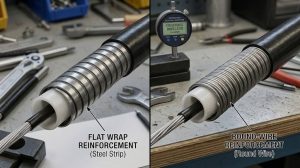
| Flat Wrap Cable Outer Casing | Compact construction | Space-constrained routing |
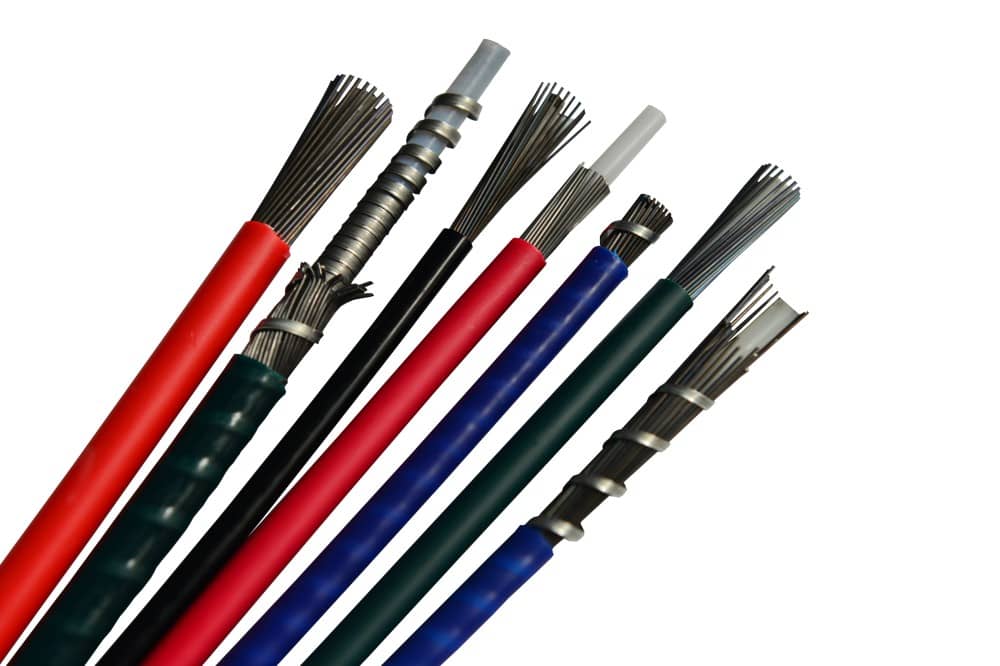
| Spring Cable Conduit | Flexible reinforced structure | Curved cable routing |
| Double-Wire Reinforced Conduit | Rigidity and anti-crush performance | Higher external loading |
| Protective Sleeve | External protection | Abrasion and environmental exposure |
The correct choice should be based on the complete cable system rather than the conduit name alone.
Push-Pull Outer Casing
A push-pull cable conduit must provide sufficient structural support for force transmission while allowing the required cable movement. Key considerations include:
- Push-pull force
- Compression resistance
- Flexibility
- Bend radius
- Cable stroke
- Routing conditions
Flat Wrap Cable Outer Casing
A flat wrap cable outer casing can be considered where installation geometry requires a compact profile or controlled routing configuration. Selection should consider:
- Available installation space
- Required flexibility
- Cable dimensions
- Routing path
- External loading
Spring Cable Conduit
Spring cable conduit provides a flexible reinforced structure for applications where the cable must follow curved routing paths. Evaluate:
- Dynamic bending
- Minimum bend radius
- Cable movement
- External protection
- Routing geometry
Double-Wire Reinforced Conduit
Double-wire reinforced conduit is useful when a control cable requires increased structural support and anti-crush performance.
The reinforcement can help maintain conduit geometry when external forces are present while retaining the flexibility required for routing.
Protective Sleeve
A protective sleeve serves a different function from a structural control cable conduit. It can provide additional protection against abrasion, environmental exposure, or contact with surrounding components.
Therefore, it should be evaluated according to whether the application needs: structural cable guidance, external protection, or both.
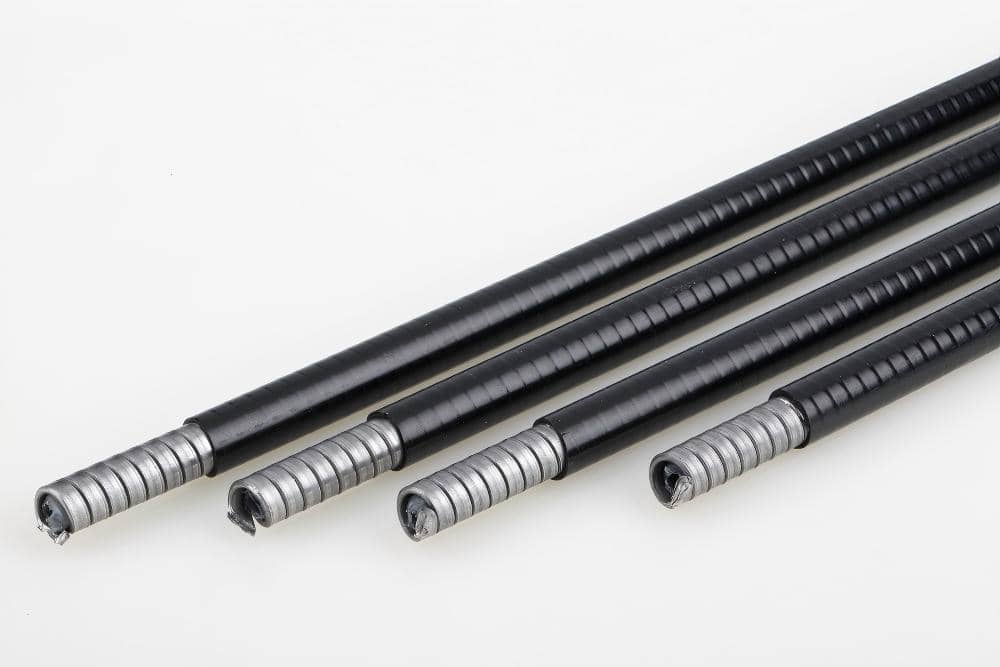
How Does Application Location Affect Control Cable Conduit Selection?
The installation location directly affects the requirements placed on an automotive cable conduit.
| Automotive Location | Typical Challenge | Key Selection Consideration |
| Engine compartment | Heat, vibration, fluids | Temperature and environmental resistance |
| Transmission area | Heat, movement, limited space | Flexibility and routing stability |
| Underbody | Water, dirt, abrasion | Environmental and abrasion resistance |
| Door system | Repeated movement | Dynamic bending |
| Hood/trunk | Repeated opening and closing | Flexibility and fatigue resistance |
| Interior controls | Limited space | Compact routing and smooth movement |
Engine Compartment
Control cables near the engine may experience heat, vibration, oil, and restricted routing space. The conduit construction should therefore be selected based on actual operating temperature, environmental exposure, cable movement, and available routing space.
Door, Hood and Trunk Systems
Door locks, hood releases, and trunk mechanisms commonly involve repeated cable movement. A suitable Bowden cable conduit should accommodate repeated bending while maintaining consistent cable movement.
For door-lock systems, the complete system should be evaluated: wire rope, Bowden Cable Conduit, Connector, and Routing.
Transmission and Mechanical Control Systems
Transmission-related control systems may require reliable push-pull force transmission through complex routing paths. Important considerations include:
- Compression resistance
- Bend radius
- Flexibility
- Cable stroke
- Routing stability
- Operating temperature
For these systems, the conduit should maintain its geometry sufficiently to support consistent cable movement throughout the required stroke.
How Does Control Cable Conduit Design Affect Friction?
Control cable friction is influenced by the interaction between the inner cable, liner, conduit geometry, bend radius, and routing conditions. A low-friction control cable system therefore cannot be evaluated by conduit material alone.
1. Inner Liner
The liner forms the interface between the moving cable and the surrounding conduit structure. Its material, dimensional consistency, and surface characteristics can influence:
- Friction
- Wear
- Cable movement
- Operating force
For applications requiring controlled friction, the liner should be evaluated together with the inner cable and operating environment.
2. Bend Radius
Tight bends increase interaction between the inner cable and liner. As routing becomes more severe, cable movement may require greater operating force.
This is why control cable conduit bend radius should be considered during both component selection and vehicle routing design.
3. Conduit Alignment
Incorrect routing can introduce additional bends or localized deformation even when the conduit itself has sufficient flexibility. Clips and brackets should maintain the intended cable path without creating excessive compression or sharp directional changes.
4. Material and Surface Selection
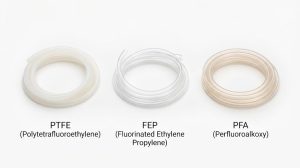
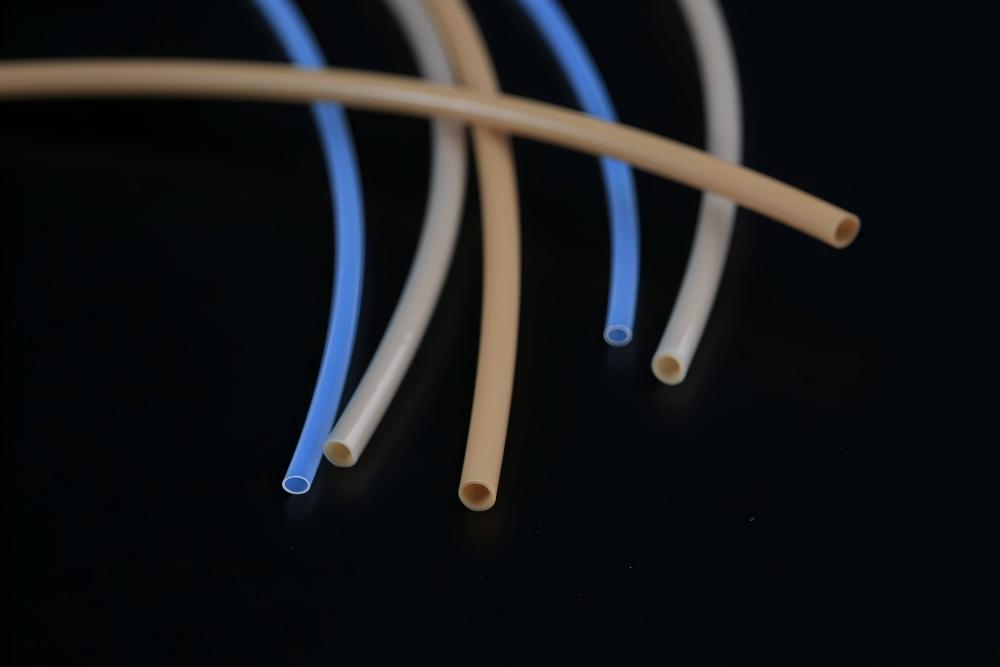
Material selection can affect friction, wear, temperature resistance, and environmental durability. Where appropriate, engineering materials such as high-precision PTFE tubing may be considered for low-friction components or liners.
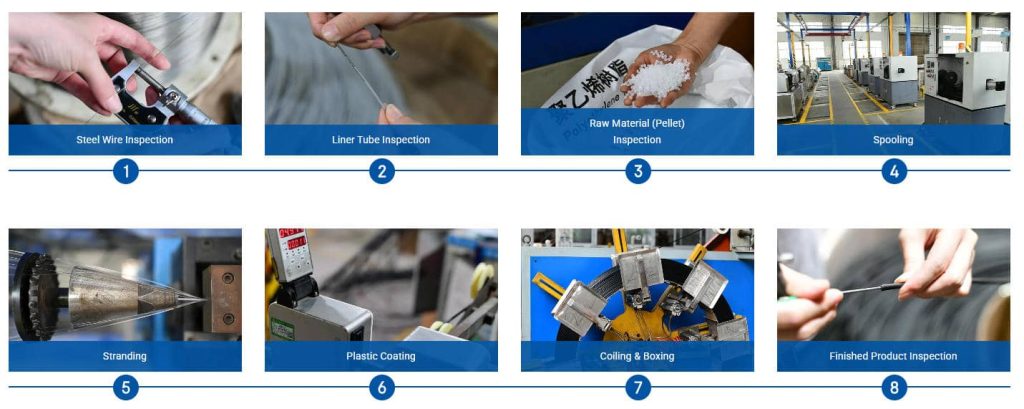
How to Select Control Cable Conduit: A Practical Engineering Process
A systematic selection process helps engineers avoid choosing a conduit based on only one specification.
Step 1: Define the Cable Function
Identify whether the system requires:
- Pull-only movement
- Push-pull transmission
- Release
- Locking
- Adjustment
- Mechanical actuation
Step 2: Define the Routing Conditions
Document:
- Routing length
- Available space
- Bend locations
- Minimum bend radius
- Fixing points
- Moving sections
- Stationary sections
Step 3: Define Mechanical Requirements
Determine:
- Operating load
- Compression load
- Cable stroke
- Bending frequency
- Vibration exposure
- Required service life
Step 4: Define Environmental Requirements
Identify exposure to:
- Temperature
- Oil
- Grease
- Water
- Dust
- Chemicals
- UV
- Abrasion
Step 5: Select the Conduit Construction
Compare the requirements with available constructions:
Push-Pull → Flat Wrap → Spring → Double-Wire Reinforced
The objective is not to choose the most reinforced conduit. It is to choose the construction that provides the required balance of flexibility, protection, compression resistance, and routing stability.
Step 6: Confirm Dimensions and Tolerances
Confirm:
- Inner diameter
- Outer diameter
- Wall thickness
- Length
- Tolerances
- End configuration
Step 7: Validate the Complete Cable System
The final selection should be evaluated as: Inner Cable, Control Cable Conduit, Connector, End Fittings and Routing
This is particularly important for OEM projects because the interaction between components can affect the actual performance of the installed system.
When Should You Choose a Custom Control Cable Conduit?
Standard configurations may be suitable for common applications, but custom control cable conduit becomes valuable when a cable system has specific dimensional, mechanical, environmental, or assembly requirements.
Typical customization parameters include:
| Parameter | Possible Requirement |
| Inner diameter | Application-specific |
| Outer diameter | Space-specific |
| Length | Custom |
| Reinforcement | Application-specific |
| Jacket material | Environmental requirement |
| Color | OEM identification |
| Bend performance | Routing-specific |
| Temperature resistance | Application-specific |
| Connector | Custom end configuration |
For an OEM project, buyers should provide the cable diameter, conduit dimensions, routing drawing, bend radius, operating temperature, environmental exposure, expected movement, mechanical load, and connector requirements.
Control Cable Conduit Selection Checklist
Before ordering an automotive control cable conduit, confirm:
| Question | Requirement to Confirm |
| What is the inner cable diameter? | Cable and conduit compatibility |
| What ID and OD are required? | Available space and clearance |
| What is the minimum bend radius? | Routing and movement |
| Is the cable pull-only or push-pull? | Required conduit construction |
| What compression resistance is required? | External loading |
| What temperature will the conduit experience? | Material suitability |
| Will it contact oil, water, or chemicals? | Environmental resistance |
| Is abrasion resistance required? | Outer protection |
| How much repeated bending will occur? | Dynamic performance |
| Are custom dimensions or connectors required? | OEM configuration |
The right control cable conduit should be selected according to the complete operating environment rather than a single specification. Cable diameter, bend radius, compression resistance, friction, temperature, environmental exposure, routing space, and service requirements all contribute to system performance.
For OEM automotive projects, evaluating the control cable casing, inner cable, connectors, and routing conditions as one system provides a more reliable basis for engineering selection.
Keli's product range allows engineers to evaluate different conduit constructions according to application requirements, including push-pull, flat-wrap, spring, reinforced, and protective configurations.
Frequently Asked Questions
Q1: What is a control cable conduit?
A control cable conduit is the outer structure that surrounds and guides an inner cable, providing mechanical support, protection, and controlled flexibility for reliable cable movement.
Q2: How do I choose the correct control cable conduit size?
Start with the inner cable diameter, required clearance, available installation space, bend radius, and cable movement. Then confirm conduit ID, OD, wall thickness, length, and tolerances.
Q3: Why is bend radius important for control cable conduit?
Bend radius affects cable friction, movement, and wear. Excessively tight bends can increase operating resistance, create uneven contact, and reduce complete cable-system service life.
Q4: What type of conduit is suitable for push-pull cables?
Push-pull systems generally require a conduit that combines flexibility with sufficient compression resistance and dimensional stability. The exact construction depends on load, routing, stroke, and environment.
Q5: Can automotive control cable conduit be customized?
Yes. Depending on project requirements, conduit can be customized for dimensions, length, reinforcement, materials, color, bending performance, environmental conditions, and compatible connectors.
Q6: What information should I provide for a custom conduit?
Provide the cable diameter, required ID and OD, length, bend radius, routing drawing, temperature, environmental exposure, mechanical load, cable stroke, and connector requirements.