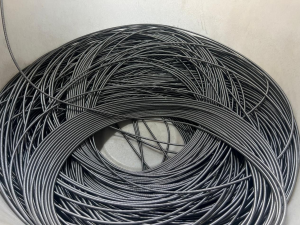
Choosing between PTFE vs FEP vs PFA tubing requires more than comparing chemical resistance. These three fluoropolymers offer excellent resistance to many chemicals, high-temperature capability, electrical insulation, and low surface energy, but their flexibility, transparency, processing characteristics, dimensional performance, and application suitability differ.
PTFE tubing is often selected for high-temperature, low-friction, chemical-resistant, and electrical insulation applications. FEP tubing can be advantageous when transparency, flexibility, and chemical resistance are required. PFA tubing is frequently considered for high-purity fluid handling, aggressive chemicals, transparency, and demanding temperature conditions.
This guide compares PTFE vs FEP vs PFA tubing from a practical engineering and procurement perspective, covering material properties, tube specifications, manufacturing, applications, and supplier selection.
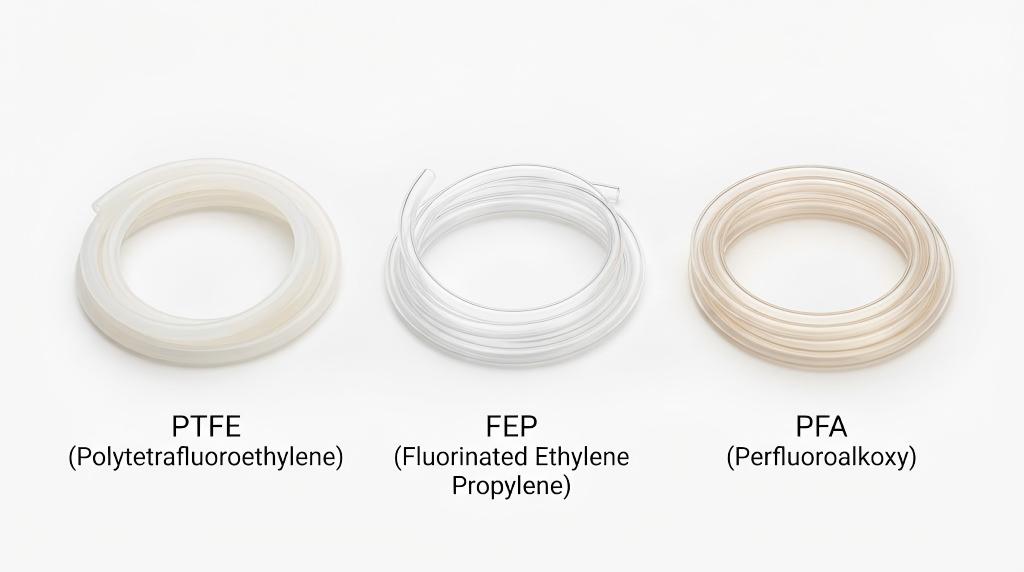
PTFE vs FEP vs PFA Tubing: What Is the Difference?
PTFE, FEP, and PFA are fluoropolymer materials with excellent chemical resistance and electrical insulation. However, differences in molecular structure and processing characteristics make each material suitable for different tubing requirements.
| Property | PTFE Tubing | FEP Tubing | PFA Tubing |
| Chemical resistance | Excellent | Excellent | Excellent |
| High-temperature capability | Excellent | High | Excellent |
| Flexibility | Moderate | High | Moderate–High |
| Transparency | Limited | Excellent | Excellent |
| Low friction | Excellent | Very good | Very good |
| Electrical insulation | Excellent | Excellent | Excellent |
| Melt processing | Specialized | Yes | Yes |
| Typical selection focus | Temperature, friction, chemicals | Flexibility, transparency | Purity, chemicals, temperature |
The main difference between PTFE vs FEP vs PFA tubing is therefore the balance of performance required by the application. There is no single fluoropolymer that is automatically the best choice for every tubing system.
PTFE Tubing: When Should You Choose It?
PTFE tubing is a strong choice for applications requiring a combination of high-temperature capability, chemical resistance, low friction, and electrical insulation.
Typical reasons to specify PTFE tube include:
- High operating temperatures
- Aggressive chemical exposure
- Low-friction fluid or mechanical interfaces
- Electrical insulation
- Low moisture absorption
- Small-diameter precision tubing
- Protection for wires, sensors, and components
For precision applications, material properties alone are not enough. PTFE tube ID, OD, wall thickness, and dimensional tolerance can directly affect assembly, fluid flow, sealing, and installation.
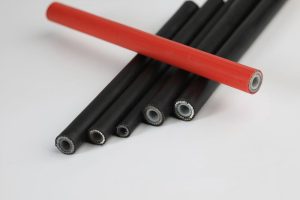
Keli manufactures high-precision PTFE tubing with OD from 1.8 to 12 mm and ID from 1.5 to 11 mm, with a minimum wall thickness from 0.12 mm and defined dimensional tolerances. These capabilities make custom PTFE tubing suitable for applications where controlled dimensions are required around cables, sensors, fluid passages, connectors, and other components.
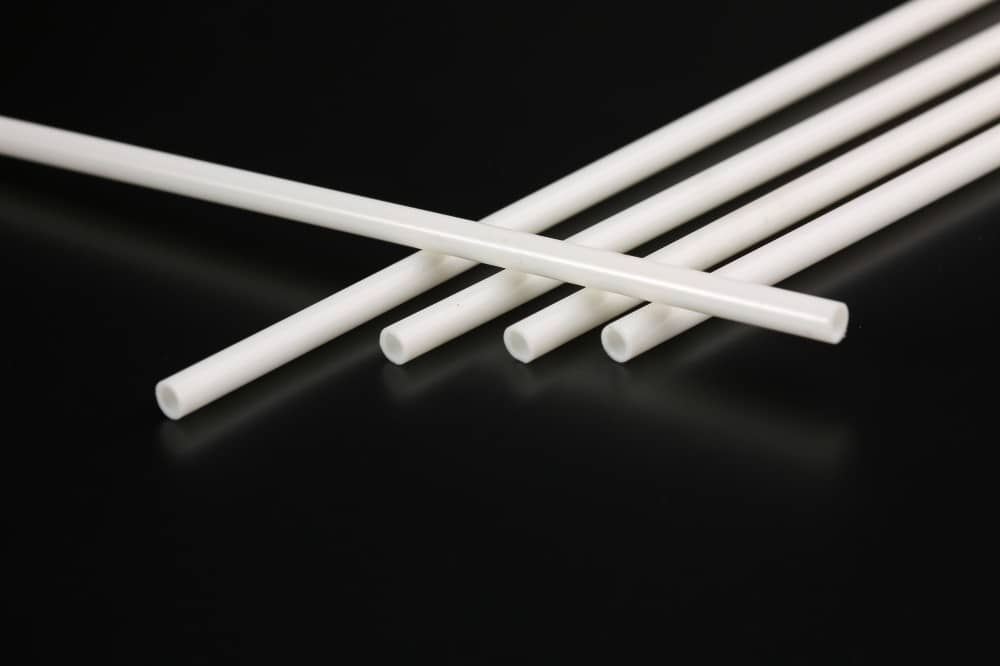
FEP Tubing: When Does FEP Have an Advantage?
FEP tubing provides excellent chemical resistance while offering a useful combination of flexibility and transparency.
The transparency of FEP tube can be valuable when engineers or operators need to visually inspect:
- Fluid movement
- Bubbles
- Contamination
- Flow conditions
- Process changes
When comparing PTFE vs FEP tubing, flexibility and transparency are two important selection factors. FEP can be considered where these characteristics are required together with fluoropolymer chemical resistance.
Typical FEP tubing applications are chemical transfer, laboratory equipment, instrumentation, fluid handling and process systems requiring visual inspection. But the selection of material should also take into account the temperature, pressure, tube dimensions, fittings and the actual chemical environment, in addition to flexibility or transparency.
PFA Tubing: When Is PFA the Right Choice?
PFA tubing is frequently considered for demanding fluid-handling applications where chemical resistance, transparency, purity, and temperature performance are important.
Typical PFA tube applications include:
- High-purity chemical transfer
- Semiconductor processing
- Pharmaceutical systems
- Laboratory fluid handling
- Aggressive chemical environments
- High-temperature fluid systems
When comparing PTFE vs PFA tubing, PFA may be considered when high-purity fluid handling and transparent tubing are important alongside chemical and temperature resistance.
PFA should not, however, be treated as a universal replacement for PTFE. The correct material depends on the chemical environment, temperature, pressure, purity requirements, dimensions, tolerances, and manufacturing process.
PTFE vs FEP vs PFA: Key Performance Comparison
The following table provides a practical starting point for PTFE, FEP, and PFA tubing selection:
| Selection Factor | PTFE | FEP | PFA |
| High-temperature performance | Excellent | High | Excellent |
| Chemical resistance | Excellent | Excellent | Excellent |
| Flexibility | Moderate | High | Moderate–High |
| Transparency | Limited | Excellent | Excellent |
| Low friction | Excellent | Very good | Very good |
| Electrical insulation | Excellent | Excellent | Excellent |
| High-purity applications | Suitable | Suitable | Particularly suitable |
| Melt processing | Specialized | Yes | Yes |
| Precision tubing | Excellent | Application-dependent | Application-dependent |
This comparison should be used as a selection framework, not as a universal ranking of the materials. For example, an application that requires low friction and high temperature performance may favour PTFE, whereas a transparent fluid line may favour FEP or PFA. If the chemical system is of higher purity, PFA, PTFE or some other fluoropolymer may need to be reviewed more closely, depending upon the actual process conditions.
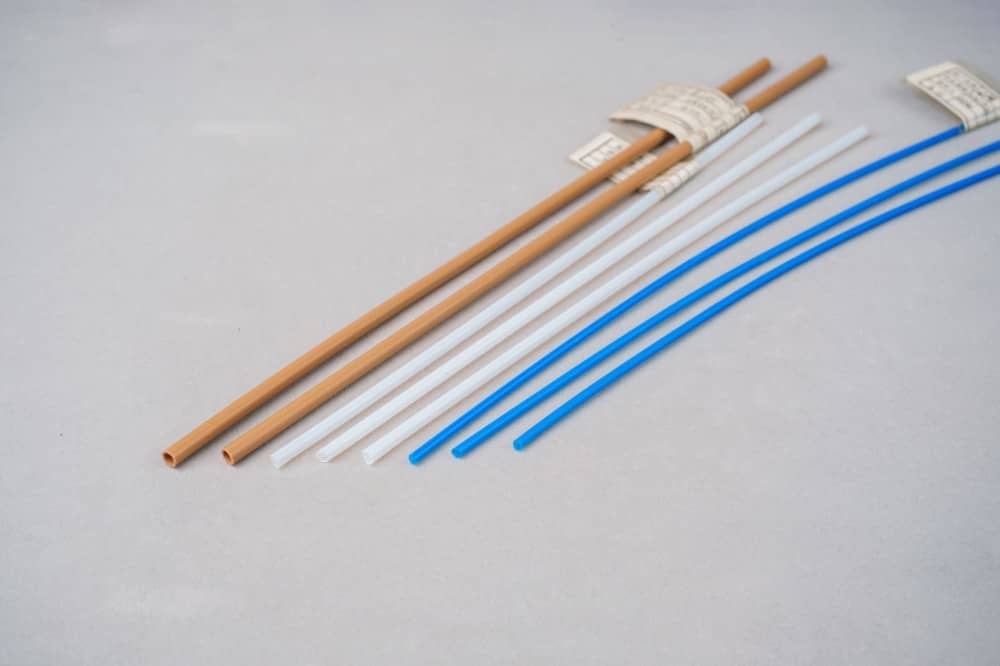
How to Choose Between PTFE, FEP and PFA Tubing
A reliable fluoropolymer tubing selection process should begin with the operating conditions rather than the material name.
1. Define the operating temperature: Identify both continuous operating temperature and short-term peak temperature. Temperature exposure can affect dimensional stability, pressure capability, and service life.
2. Check chemical compatibility: Identify every chemical or fluid contacting the tube, including cleaning chemicals, process fluids, and potential contaminants.
3. Determine flexibility requirements: Consider minimum bend radius, vibration, repeated movement, installation space, and whether the tubing will remain stationary.
4. Determine whether transparency is required: If operators need to observe fluid flow or contamination, transparent FEP or PFA tubing may offer an advantage.
5. Define purity requirements: Semiconductor, pharmaceutical, laboratory, and other controlled environments may require specific material, manufacturing, cleaning, and documentation requirements.
6. Specify ID, OD and wall thickness: The PTFE tube ID, OD, and wall thickness influence fluid flow, component insertion, fitting compatibility, flexibility, mechanical protection, and installation space.
7. Define dimensional tolerance: Precision OEM applications may require controlled ID and OD tolerances to maintain consistent assembly and product performance.
8. Evaluate the tubing manufacturer's capabilities: A PTFE tubing manufacturer should be evaluated based on material capability, extrusion technology, dimensional control, inspection methods, customization, prototyping, and production scalability.
How Tubing Specifications Affect Material Selection
Selecting PTFE, FEP, or PFA is only the first step. Tube geometry can significantly affect final performance.
- Internal diameter (ID) affects fluid flow, pressure drop, cable insertion, and connector compatibility. For precision fluid systems, small dimensional variations can influence flow behavior and assembly consistency.
- Outside diameter (OD) affects installation space, fittings, routing, and interfaces with other components.
- Wall thickness influences flexibility, mechanical protection, insulation and dimensional stability. Thin wall tubing can be useful where flexibility and small dimensions are important, while thicker wall constructions may provide more mechanical support.
- Dimensional tolerance is particularly important for OEM applications and automated assembly. Consistent ID and OD can improve fitting accuracy and reduce production variation.
For example, Keli offers a range of high precision PTFE tubing supporting OD from 1.8-12mm, ID from 1.5-11mm and minimum wall thickness from 0.12mm. These specifications can be combined with custom tubing requirements depending on the application.
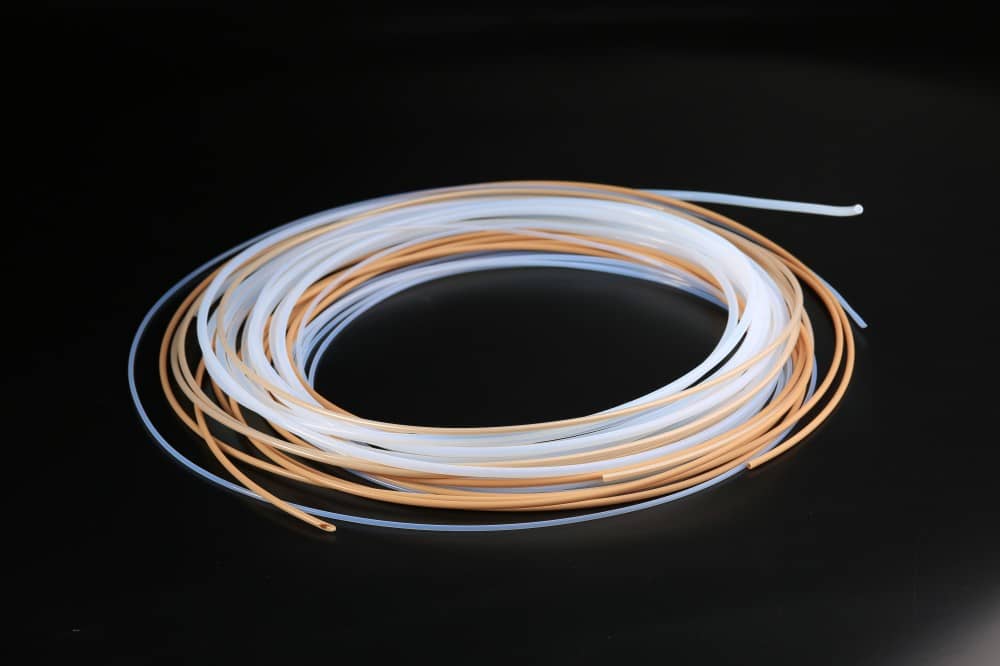
Keli also uses paste extrusion, ram extrusion, mandrel extrusion, and multi-cavity extrusion for different PTFE tubing configurations. Laser micrometers and vision inspection systems support dimensional quality control, including in-line inspection. For OEM applications requiring controlled dimensions, see the high-precision PTFE tubing product page.
What Should Buyers Ask a Fluoropolymer Tubing Manufacturer?
When sourcing custom PTFE tubing, FEP tubing, or PFA tubing, buyers should evaluate the manufacturer's engineering and production capabilities rather than comparing material price alone.
| Buyer Question | Why It Matters |
| What material grades are available? | Determines application suitability |
| What ID and OD tolerances can be achieved? | Affects assembly and flow |
| What wall thicknesses are available? | Influences flexibility and protection |
| Which extrusion process is used? | Affects dimensional consistency |
| Can custom dimensions be manufactured? | Important for OEM applications |
| How are ID and OD inspected? | Supports dimensional consistency |
| Is 100% inspection available? | Helps identify production variation |
| Can prototypes be developed? | Reduces design and tooling risk |
| Can production scale to volume? | Supports long-term OEM programs |
| What quality records are available? | Supports procurement and quality control |
A capable fluoropolymer tubing manufacturer should be able to connect material selection with tube dimensions, extrusion technology, tooling, inspection, and application requirements. For Keli, this includes multiple PTFE extrusion methods, precision dimensional measurement, customized tube configurations, and production inspection capabilities.
In the end, the decision of PTFE vs FEP vs PFA tubing should be based on the complete application: temperature, chemical exposure, pressure, flexibility, transparency, purity, ID, OD, wall thickness, tolerance, and manufacturing requirements.
PTFE is often considered for high temperature and low friction. It also has good chemical resistance and electrical insulation. FEP can be suitable where flexibility and transparency are important, and PFA is often used for challenging chemical and high-purity applications.
So the right tubing material is not necessarily the highest spec. The material and tube construction deliver the performance, dimensional consistency, manufacturability, and service life needed for the actual application.
FAQ
Q1: Is PTFE better than FEP for tubing?
A1: It really depends on what you need. PTFE tubing is usually the go-to for jobs involving high temperatures and needing things to slide easily. FEP tubing might be a better choice if you need to see through it or if it needs to bend a lot.
Q2: What is the difference between PTFE and PFA tubing?
A2: Both kinds are really good with chemicals and can handle high temperatures. PFA tubing is clear and can be melted and reshaped, while PTFE is often picked for its low friction, ability to withstand high heat, and use in precise tubing tasks.
Q3: Which is more flexible, PTFE or FEP tubing?
A3: FEP tubing is generally more flexible than conventional PTFE tubing. Actual flexibility also depends on tube ID, OD, wall thickness, construction, temperature, and the requirements of the installation.
Q4: Is PFA better than PTFE for high-purity applications?
A4: PFA is frequently considered for high-purity fluid handling because of its chemical resistance, transparency, and processing characteristics. The appropriate material still depends on the specific process, temperature, chemical, and purity requirements.
Q5: Which fluoropolymer tubing is best for chemical applications?
A5: PTFE, FEP, and PFA can all provide excellent chemical resistance. The correct choice depends on the specific chemical, concentration, temperature, pressure, exposure time, and required tubing dimensions.
Q6: Can PTFE tubing be custom manufactured?
A6: Yes. Custom PTFE tubing can be produced with application-specific ID, OD, wall thickness, length, geometry, and tolerance requirements, subject to the manufacturer's tooling and extrusion capabilities.