When the OEM mechanical control system must deliver reliable motion through a curved or space-constrained routing path, the choice of the proper push-pull cable conduit is important. The conduit does more than just protect the inner cable. Its liner, reinforcement, dimensions, flexibility and compression resistance are directly responsible for the system’s operating force, stroke efficiency, durability and overall performance.
For OEM applications, the correct push-pull cable conduit should therefore be selected from the complete operating requirements—not simply by cable diameter or outer appearance.
This guide explains the key factors engineers and purchasing teams should evaluate when specifying a push-pull cable conduit for OEM applications, from cable dimensions and force requirements to bend radius, materials, temperature, testing, and supplier qualification.
What Is a Push-Pull Cable Conduit?
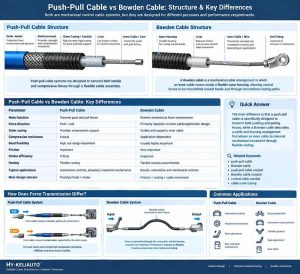
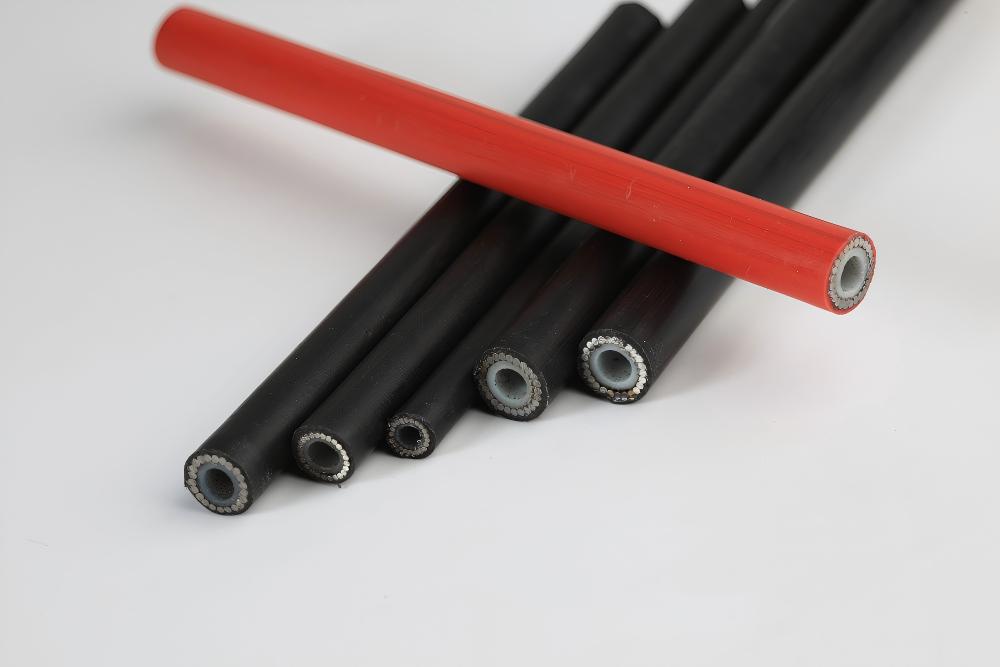
A push-pull cable conduit is the outer casing or housing that guides an inner cable while providing the mechanical support required for controlled push-and-pull movement.
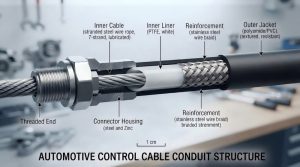
A typical system may include:
- Inner cable or core
- Low-friction liner
- Reinforcement layer
- Outer protective coating
- End fittings or connectors
The inner cable transmits movement, while the push-pull cable conduit maintains the cable path and provides resistance against deformation, particularly when the inner cable is subjected to compression. This makes conduit construction especially important for applications such as automotive door locks, seat adjustment systems, mechanical actuators, and other remote control mechanisms.
Keli currently offers push-pull outer casing as part of its control cable and conduit portfolio, alongside flat-wrap cable casing, reinforced conduit, and control cable components.
Start With the Required Push and Pull Forces
The first question for OEM engineers should be: Does the cable need to transmit pulling force only, or both pushing and pulling forces?
A conventional pull cable primarily transfers tensile force. A push-pull system must also maintain controlled movement when the inner cable is compressed.
Therefore, define:
- Maximum pull load
- Maximum push load
- Normal operating load
- Peak load
- Required safety margin
- Operating cycle frequency
For a genuine push-pull application, the conduit must provide sufficient structural support to prevent excessive deformation under compression. Higher push loads generally require greater attention to casing stiffness, reinforcement, and dimensional stability.
Match the Conduit to the Cable Diameter
Correct dimensional matching is essential. The basic parameters include:
| Specification | Why It Matters |
| Cable OD | Determines required internal clearance |
| Conduit ID | Controls cable movement and compatibility |
| Conduit OD | Determines installation space |
| Wall thickness | Influences strength and flexibility |
| Length | Affects routing and stroke |
| Dimensional tolerance | Ensures assembly consistency |
The conduit should not simply be selected with the smallest possible internal diameter. Too little clearance can increase friction and restrict movement. Excessive clearance can allow unwanted cable movement, noise, or inconsistent response.
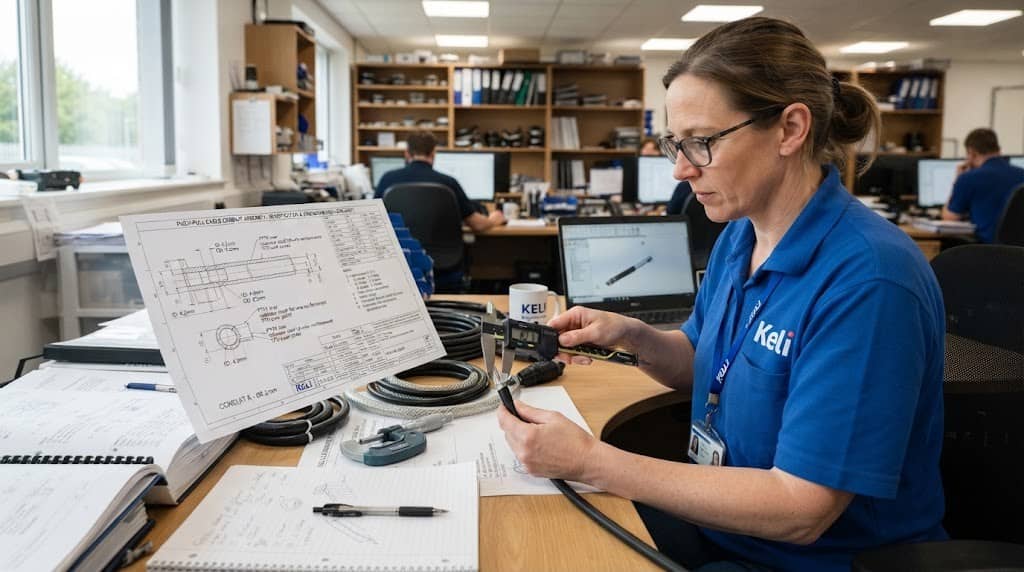
For OEM production, ID, OD, wall thickness, and tolerance should be defined together rather than specified independently.
Evaluate the Inner Liner Material
The liner is the interface between the moving cable and the conduit. Its material can have a major effect on:
- Friction
- Wear
- Operating temperature
- Chemical resistance
- Dimensional stability
- Service life
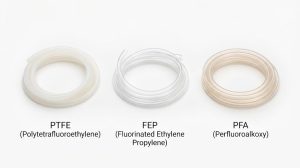
Depending on the application, liner materials may include PE, POM, PTFE, PA, or PBT. Keli's reinforced cable casing products currently offer these liner options for different operating requirements.
Typical material considerations
| Liner | Typical Advantage |
| PE | Low friction and economical |
| POM | Low friction and dimensional stability |
| PTFE | Very low friction and chemical resistance |
| PA | Strength and wear resistance |
| PBT | Thermal and dimensional stability |
The correct material depends on the complete operating environment rather than one property alone. For example, PTFE may be attractive where very low friction and chemical resistance are required, while POM may provide a practical balance of friction, dimensional stability and cost.
Determine the Required Bend Radius
Bend radius is one of the most frequently underestimated parameters when selecting a push-pull cable conduit. A cable routed through a tight bend can experience:
- Increased friction
- Higher operating force
- Localized wear
- Reduced stroke efficiency
- Increased fatigue
- Greater stress on the conduit
OEM engineers should distinguish between:
- Static bend radius — the radius created during installation.
- Dynamic bend radius — the radius experienced while the cable repeatedly moves.
A system that remains stationary may tolerate a tighter routing configuration than one that cycles continuously. For high-cycle applications, the routing path should therefore be evaluated together with conduit flexibility and reinforcement.
Select the Right Reinforcement Structure
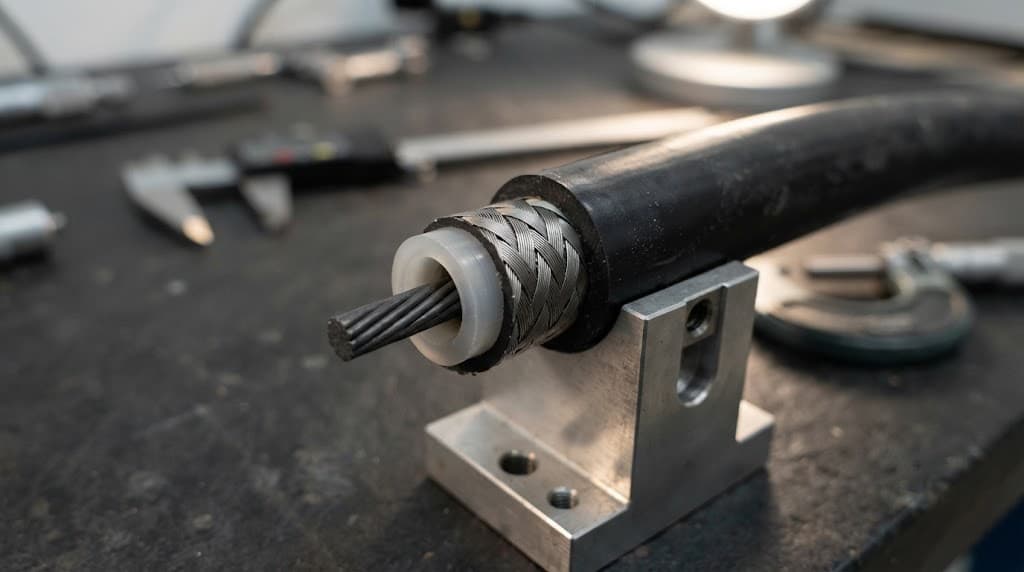
The reinforcement determines how the conduit behaves under compression, bending and external mechanical loads. Depending on the application, OEMs may consider:
- Push-pull-specific reinforced casing
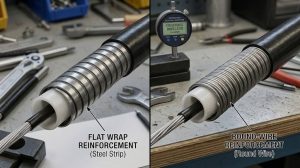
- Flat-wrap steel reinforcement
- Round-wire reinforcement
- Double-wire reinforcement
- Multi-layer reinforced conduit
Keli's product range includes several reinforced conduit constructions. Its flat-wrap cable outer casing, for example, uses steel reinforcement with configurable liner and outer coating options, while its push-pull outer casing is specifically positioned for lightweight push-pull control applications.
Selection principle
Higher flexibility is not always better. A conduit that is extremely flexible may not provide enough compression resistance for a high-load push-pull system. Conversely, excessive stiffness can increase routing difficulty and installation stress.
The objective is to balance flexibility, Compression Resistance, Friction, and Durability.
Consider Operating Temperature and Environment
The conduit must maintain its required mechanical and dimensional performance across the complete operating temperature range.
Define:
- Minimum continuous temperature
- Maximum continuous temperature
- Short-term peak temperature
- Heating/cooling cycles
- Exposure to water
- Oil or grease exposure
- Chemicals
- Dust
- Salt
- UV exposure
- Abrasion
Both the liner and outer coating should be evaluated.
Keli provides different outer coating options, including PVC, PP, PA6, PE, TPE and TPEE, allowing the conduit construction to be adapted to different environmental and mechanical requirements. For automotive applications, this is particularly important because a cable may experience vibration, temperature cycling, moisture, oil and repeated mechanical movement simultaneously.
Calculate the Required Stroke and Stroke Efficiency
A push-pull cable is not successful simply because the inner cable moves. The movement at the actuator must be transferred accurately to the controlled mechanism.
Important factors include:
- Required stroke
- Cable stretch
- Conduit compression
- Friction
- Bend radius
- End fitting movement
- Temperature-related dimensional changes
A poorly matched conduit can absorb part of the actuator movement through casing deformation or excessive friction. For OEM applications, therefore, specify the required input stroke, output stroke and acceptable stroke loss during the design stage.
Keli's published automotive FAQ specifically identifies stroke efficiency and push-pull rigidity as important performance considerations for push-pull cable applications.
Define the Required Service Life
OEM cable systems often operate thousands or millions of cycles over their service life. A conduit should therefore be evaluated under the actual movement profile rather than only through static inspection.
Consider:
Cycle frequency × stroke × bend radius × load × temperature
A high-cycle application may require more attention to:
- Liner wear
- Reinforcement fatigue
- Outer coating abrasion
- Cable friction
- Dimensional stability
- End fitting durability
The test method should reproduce the actual operating conditions as closely as possible.
Choose the Conduit Construction for the Application
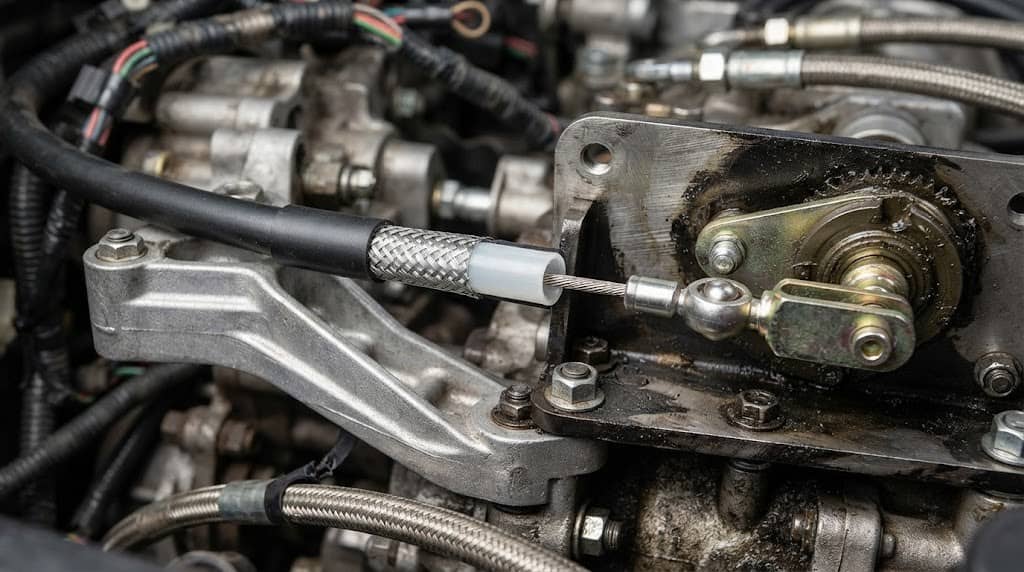
Different applications require different constructions.
| Application Requirement | Possible Conduit Direction |
| Lightweight push-pull control | Push-pull outer casing |
| High mechanical protection | Steel-reinforced conduit |
| Frequent bending | Flexible reinforced construction |
| Low friction | POM/PTFE or suitable liner |
| High abrasion | Protective outer coating |
| Compact routing | Application-specific small OD |
| High compression load | Higher structural reinforcement |
| Automotive control systems | Automotive-qualified construction |
This is why a push-pull cable conduit manufacturer should be able to customize the structure rather than offering only a fixed standard configuration.
Specify the End Connections and Installation
A technically suitable conduit can still fail to perform correctly if the installation interface is poorly designed.
OEM specifications should include:
- End fitting type
- Connection dimensions
- Mounting brackets
- Cable termination
- Retention method
- Installation orientation
- Available routing space
- Required fixing points
The conduit, cable and end fittings should be treated as one mechanical system. For custom OEM projects, Keli states that it can develop conduit dimensions and configurations from customer drawings, samples or application requirements.
Push-Pull Cable Conduit OEM Selection Checklist
Before sending an RFQ to a push-pull cable conduit manufacturer, prepare the following information:
| OEM Specification | Required Information |
| Cable | Cable OD and construction |
| Conduit | Required ID, OD and length |
| Movement | Push, pull or bidirectional |
| Load | Maximum push/pull force |
| Stroke | Required travel |
| Routing | Minimum static/dynamic bend radius |
| Environment | Temperature, water, oil, chemicals |
| Durability | Required operating cycles |
| Friction | Maximum acceptable operating force |
| Reinforcement | Required compression/support level |
| Liner | Preferred or required material |
| Coating | Environmental protection requirement |
| End fitting | Type and dimensions |
| Quality | Inspection and testing requirements |
| Volume | Prototype, annual demand and production schedule |
The more complete the specification, the easier it is for the manufacturer to recommend the correct construction.
How to Qualify a Push-Pull Cable Conduit Manufacturer
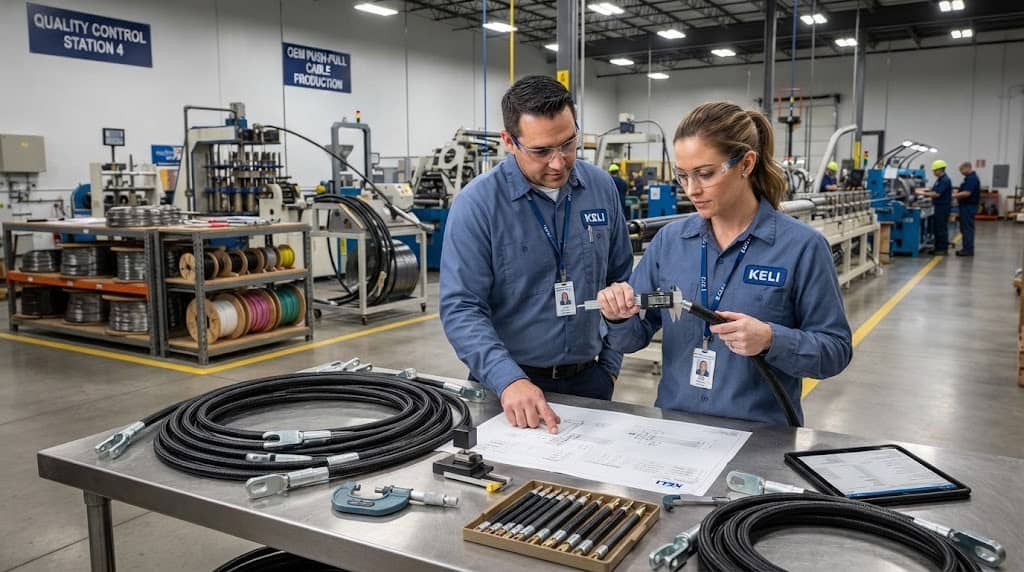
For OEM sourcing, product specifications are only part of the decision. A qualified supplier should demonstrate:
- Engineering Capability - Can the manufacturer evaluate drawings, samples, routing conditions and load requirements?
- Material Capability - Can the supplier select and process different liner, reinforcement and coating materials?
- Manufacturing Capability - Can the supplier maintain consistent ID, OD, wall thickness and mechanical properties during mass production?
- Testing Capability - Can the supplier validate friction, stroke, bending, durability and temperature performance?
- Automotive Quality System - For automotive OEM and Tier 1 projects, quality-system requirements should be evaluated alongside product performance.
Keli states that it has more than 30 years of manufacturing experience and provides OEM/ODM solutions for automotive, aerospace, medical, semiconductor, marine, agricultural machinery and industrial applications. The company also states that it operates under IATF 16949:2016 and ISO 14001 quality/environmental management systems.
For automotive projects, its FAQ also identifies QC/T 209-2007 as a manufacturing and testing reference for flexible shaft products, with additional attention to stroke efficiency and push-pull rigidity.
Why OEMs Should Consider Customized Push-Pull Cable Conduit
There is no universal conduit construction that provides the best performance for every OEM application.
A custom design can optimize:
Cable diameter → Liner → Reinforcement → Outer coating → Bend radius → End connection
This approach can improve the balance between operating force, flexibility, compression resistance, environmental protection and production requirements.
For example, Keli's cable casing manufacturing capabilities include customization of dimensions, reinforcement, liner, coating, tolerances, length and packaging according to application requirements. This makes application-specific development particularly useful when a standard conduit creates problems such as excessive friction, insufficient push rigidity, installation interference or premature wear.
FAQ: Push-Pull Cable Conduit Selection
Q1: What is the most important factor when choosing a push-pull cable conduit?
A1: Force direction should be established first. If the system must transmit both push and pull forces, the conduit must provide adequate compression resistance while maintaining smooth cable movement.
Q2: How do I determine the correct push-pull cable conduit size?
A2: Start with the cable outside diameter, required internal clearance, available installation space and movement requirements. Final ID, OD and tolerance should be validated against the complete cable assembly.
Q3: Does conduit material affect cable friction?
A3: Yes. The liner material and internal surface directly affect cable movement. POM and PTFE, for example, may be considered where low friction is important, depending on the operating environment.
Q4: Why is bend radius important for push-pull cables?
A4: Tight bends can increase friction, operating force and fatigue. Both static and dynamic bend radius should be considered when the cable moves repeatedly during operation.
Q5: Can a push-pull cable conduit be customized?
A5: Yes. OEM conduit designs can be customized by dimensions, reinforcement, liner, coating, length, tolerance and end configuration according to the application and production requirements.